
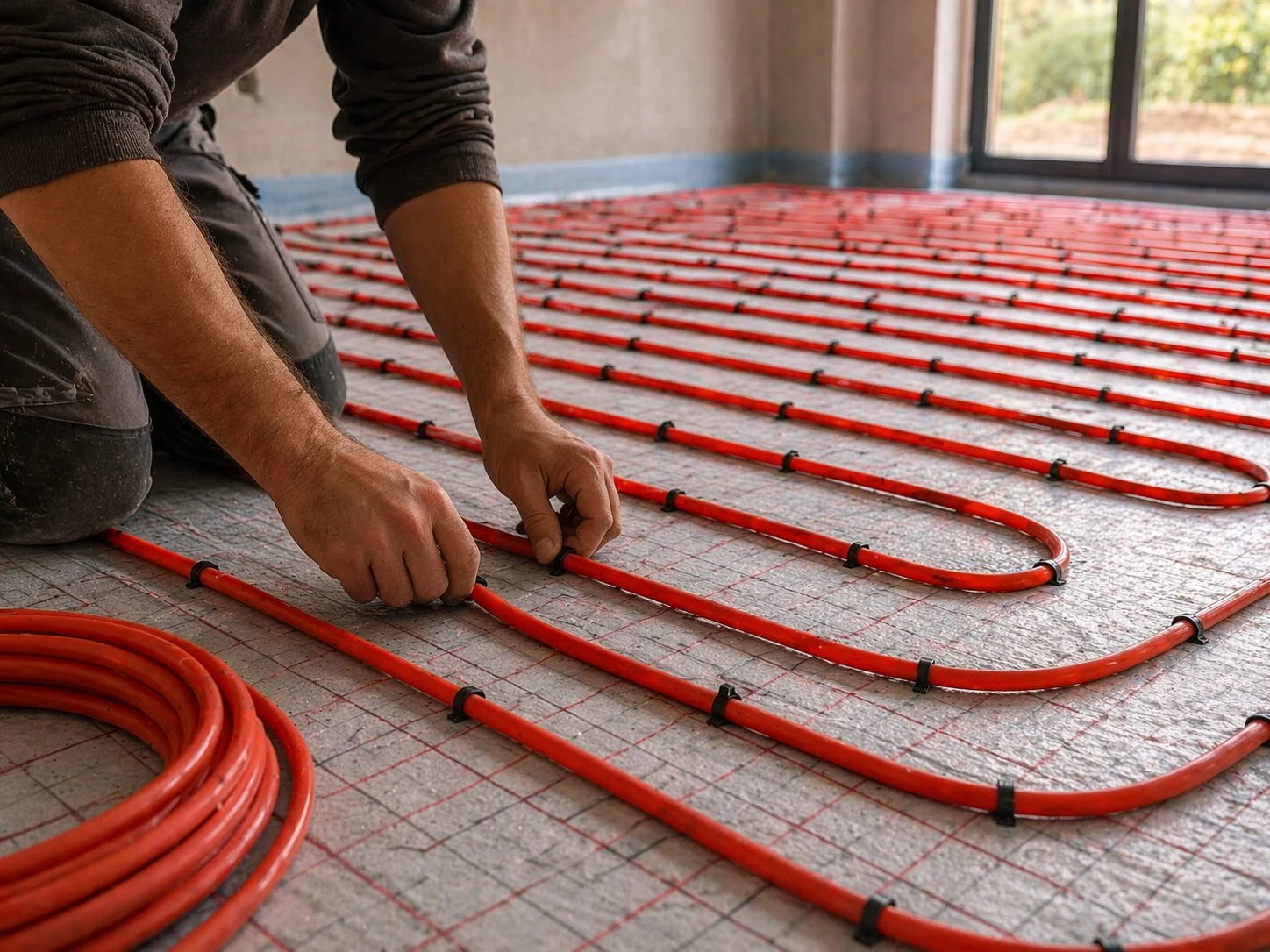
Why underfloor heating works in existing homes too
For a long time, underfloor heating was seen as something you only installed in new builds — you had to pour a new floor slab, and the height buildup made it impractical for existing homes. That's changed. Modern systems are much thinner, installation techniques have evolved, and there are now solutions for nearly every situation. The question in an existing home is usually not whether underfloor heating is possible, but which technique is the best fit.
What types of underfloor heating are there?
Water-based underfloor heating
Water-based underfloor heating works with warm water circulating through pipes embedded in or on top of the floor. A manifold distributes the water across various zones of your home, and each zone can have its own thermostat. Main benefits:
- Even heat distribution across the whole floor surface
- Energy efficient — works well at low water temperatures
- Compatible with heat pumps and high-efficiency boilers
- Low operating costs over the long term
For larger rooms and whole-floor use, water-based systems are the preferred choice.
Electric underfloor heating
Electric underfloor heating uses thin electrical mats or cables that are installed just below the floor finish. It's easier to install — especially in smaller rooms or during limited renovations.
- Perfect for bathrooms, restrooms, and kitchens
- Quick warm-up
- Minimal height buildup (often just a few millimeters)
- Simpler installation than water-based
- Higher operating cost than water-based (depends on your electricity rate)
For smaller areas and quick warm-up, electric is often the practical choice.
Options for existing homes
a. Routed-in underfloor heating in the existing screed
With this technique, grooves are cut into the existing screed (the top layer of the floor) and water-based underfloor heating pipes are laid in them. The advantages:
- No new floor slab needed — existing screed is reused
- Minimal height buildup
- Shorter working time than a complete new floor
- Works with many existing floor types
This technique does require a screed in good condition with enough thickness. Your installer checks this in advance. It's a popular choice in homes built in the 1970s, '80s, and '90s.
b. Overlay system (low-profile on top of the floor)
An overlay system goes on top of the existing floor, with pipes or mats in a thin layer. Height buildup is typically 10 to 30 mm, depending on the system. Ideal when:
- The existing screed is not suitable for routing
- You want to keep the existing floor intact
- Shorter total project time is preferred
- Work is done in phases
Watch for height transitions to doors and other rooms — these may need adjustment.
c. New screed with underfloor heating
During a major renovation, it's sometimes worth pouring a completely new screed with underfloor heating inside it. This is the "classic" approach, giving maximum flexibility in design and pipe layout. It's also the most labor-intensive and adds more height buildup, but gives the highest efficiency and lowest operating costs.
Consider this approach for complete renovations or when the existing floor is in poor shape anyway.
Thinking about underfloor heating?
AZ Grand Solutions installs water-based and electric underfloor heating in the Utrecht region. From a single bathroom to full-house systems, matched to your situation.
Request a quote More about underfloor heatingCompatible floor finishes
Not every floor finish works equally well with underfloor heating. Good heat transfer is important:
- Tile and natural stone: best heat conductors — ideal combination. Tile is the standard choice for underfloor heating in bathrooms and hallways.
- Engineered-plank parquet: compatible with underfloor heating, provided the product is rated for it. Solid hardwood floors are generally not recommended due to movement at higher temperatures.
- Laminate: often compatible, check manufacturer specifications.
- Vinyl and PVC: most modern click vinyl works with underfloor heating — verify the manufacturer's maximum surface temperature.
- Carpet: usually not a good combination — too much insulation limits heat transfer.
Practical things to watch for
Insulation under the floor
Without good insulation underneath, much of the heat is lost downward. In older homes without sufficient floor insulation, it's wise to improve that first — otherwise efficiency suffers significantly.
Height buildup
Every system adds some height — from a few millimeters with electric to several centimeters with new-screed installation. This affects door heights, stair risers, and transitions to rooms not being done. Include this in the plan from the start.
Time investment
Underfloor heating is not done in a day. Routing takes a few days, and a new screed needs weeks to dry out before the floor finish can be applied. Plan in time for drying — and if possible, avoid living in the work area during installation.
Disruption during the work
The work area must be cleared out. Plan where you'll stay and which rooms remain usable. A good installer coordinates the work with other trades — tiling, floor finish, painting — to keep the project running smoothly.
Combining with other renovations
Underfloor heating is often a good moment to combine with other work. Think about:
- New floor finish (tile, parquet, vinyl)
- Bathroom renovation
- Kitchen renovation
- Replacing radiators or removing them entirely
- Improving insulation
- Paintwork after the installation
Combining work saves on duplicate costs and keeps total disruption shorter. One coordinated project usually comes out better than several back-to-back renovations.
When is underfloor heating a good investment?
Underfloor heating is worth considering if:
- You plan to live in the home for 10 or more years
- You're doing a floor renovation anyway
- You have (or are planning) a heat pump
- You want to get rid of visible radiators
- Children often play on the floor and comfort matters
- You have, or want to have, a well-insulated home
For short-term living situations or homes with very limited insulation, the investment often makes less sense.
What does it cost?
Costs vary widely with the technique, size, and situation. General guidelines:
- Electric underfloor heating: often a relatively affordable option for small rooms like bathrooms.
- Routed-in water-based: medium investment — existing screed is reused.
- Overlay system: varies based on system and size — often a middle option.
- New screed with underfloor heating: the most extensive option, with the highest efficiency long-term.
For a realistic cost estimate, an on-site visit is needed. We'll look at the floor buildup, the heating system, the height available, and combining with other work. Based on that, you get a no-obligation quote with a clear breakdown.


